
I am an Assistant Professor of Finance at the University of Minnesota Twin Cities. My research focuses on financial intermediation and macro-finance. I am currently teaching a course on Financial Markets and Interest Rates. Previously, I was an Assistant Professor at the City University of Hong Kong, where I taught courses on Security Analysis and Asset Management.
Interests
- Macrofinance
- Financial Institution
- Financial Intermediation
- Central Banking
- Asset Pricing
Education
-
PhD in Finance, 2022
Stanford University
-
MS in Mathematics, 2016
University of Michigan, Ann Arbor
-
MA in Economics, 2016
University of Michigan, Ann Arbor
-
BS in Finance and Mathematics (double major), 2014
Wake Forest University
Publications
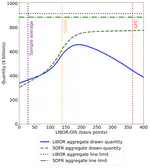
Transition from credit-sensitive benchmarks like LIBOR to risk-free rates like SOFR can quietly tighten credit supply.
Abstract
Corporate credit lines are drawn more heavily when funding markets are more stressed. This covariance elevates expected bank funding costs. We show that credit supply is dampened by the associated debt-overhang cost to bank shareholders. Until 2022, this impact was reduced by linking the interest paid on lines to credit-sensitive reference rates such as LIBOR. We show that transition to risk-free reference rates may exacerbate this friction. The adverse impact on credit supply is offset if drawdowns are expected to be left on deposit at the same bank, which happened at some of the largest banks during the COVID recession.
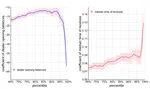
Quantitative Tightening increases the risk of a dollar funding squeeze. Delayed intraday payments to the largest dealer banks may act as an early-warning signal.
Abstract
We show that the likelihood of a liquidity crunch in wholesale US dollar funding markets is highly dependent on levels of reserve balances at the financial institutions that are the most active intermediaries of these markets. Heightened risk of an imminent liquidity crunch is signaled by significant delays in intra-day payments to these large financial institutions over the prior two weeks. Our study contributes to the broader dialogue surrounding the Federal Reserve’s ongoing quantitative tightening (QT).
Working Papers
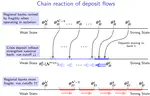
A slightly more stable national bank drains deposits from regional neighbors during crises, endogenously strengthening the national bank and weakening the regional ones. Implication: Macroprudential policies calibrated on isolated single-bank models tend to over-fortify national institutions.
Abstract
This paper identifies a novel bank-run externality: when depositors can shift funds across risky banks in a crisis, a large national bank perceived as safer may disproportionately raise the likelihood of runs among smaller regional banks. A minor shock can prompt a cascading chain reaction of deposit withdrawals among many regional banks, generating systemic vulnerabilities beyond traditional interbank-contagion channels. We extend global game models by allowing realistic deposit mobility across multiple risky banks, alongside the conventional risk-free option. Our framework captures the interaction between strategic complementarity in run/stay decisions among multiple substitutes—a dynamic that remains underexplored in the literature.
- Generalized global-games bank run models with multiple run options
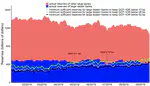
Low reserve supply causes banks to strategically delay payments and hoard liquidity, impeding monetary policy implementation. A game-theoretic model calibrated using 2019 data offers a quantitative framework to determine the minimum sufficient size of the Federal Reserve’s balance sheet.
Abstract
What quantity of reserves is sufficient to support effective monetary policy implementation and an efficient interbank payment system? To answer this question, I construct a model that links interbank intraday payment timing to monetary policy implementation. I show that a low reserve supply causes banks to delay payments to each other and strategically hoard reserves, which in turn disincentivizes banks from providing liquidity to short-term funding markets, driving up the spreads between overnight risk-free market rates and the central bank deposit rate and, impeding monetary policy implementation. As reserve balances get sufficiently low, even small reductions in reserves can have large impacts on these spreads, mirroring the repo-spike event observed in September 2019. The model also provides a counterfactual analysis of the sufficient reserve level that could have prevented the September 2019 repo spike, offering insights into the current discussions about the appropriate size of the Federal Reserve’s balance sheet.
- Revise & Resubmit, JFE
- WFA 2022 Brattle Group Ph.D. Candidate Awards For Outstanding Research
- The BlackRock Applied Research Award 2021 (runner-up)
In high-dimensional markets, inferring information from prices becomes so complex that agents pivot to simple, localized ridge regressions—an ε-rational strategy profile that explains massive trading volume spikes on earnings dates.
Abstract
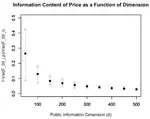
We study a trading game with agents who face a high-dimensional estimation problem. In the presence of a curse of dimensionality, we show rational expectations equilibrium is ε-approximated by a strategy profile in which each agent uses only a ridge regression on her own data to forecast the fundamental’s distribution and does not make inference on price in her demand curve submission. We document how such an equilibrium matches survey evidence about modern trading processes. We derive quantitative properties of price’s prediction risk and equilibrium trading volume, introducing a “regularization externality” in price formation and accounting for trading volume spikes on earnings dates.
Other Publications
Abstract
Given a positive integer n, we let sfp(n) denote the squarefree part of n. We determine all positive integers n for which max{sfp(n),sfp(n+1),sfp(n+2)}<=150 by relating the problem to finding integral points on elliptic curves. We also prove that there are infinitely many n for which max{sfp(n),sfp(n+1),sfp(n+2)}<n^(1/3).
Abstract
We consider matrix-vector equations of the form Ax = f(x) that are motivated by nonlinear oscillating systems such as the Tacoma Narrows Bridge. We identify a particular set, called the Fučı´k Spectrum, which is relevant to questions of solvability, and we develop theorems to describe the spectrum and show how it relates to the solvability of the matrix equation.
Teaching
At the City University of Hong Kong, I am teaching two courses below.
- Fall 2022-Fall 2024: EF4328 Asset Management
- Fall 2022-Fall 2024: EF3320 Security Analysis and Portfolio Management